undefined Cover
undefined Cover

The punctuality map: Punctuality, delays, and cancellations at a glance

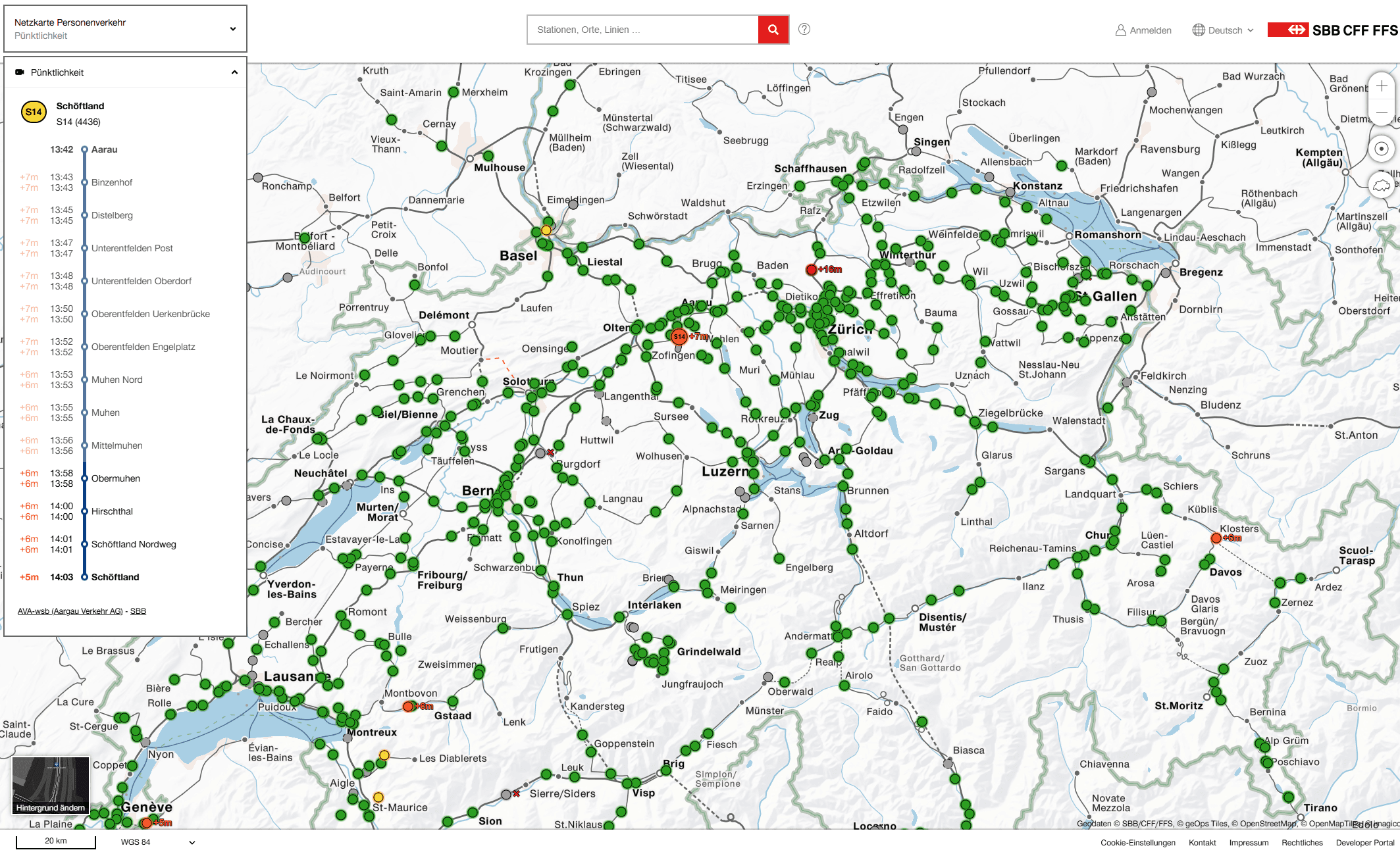
Live maps are used as a valuable source of information for travelers. However, they can also be used to provide an overview of the current status of public transport operations.

Strong visualization in extreme situations

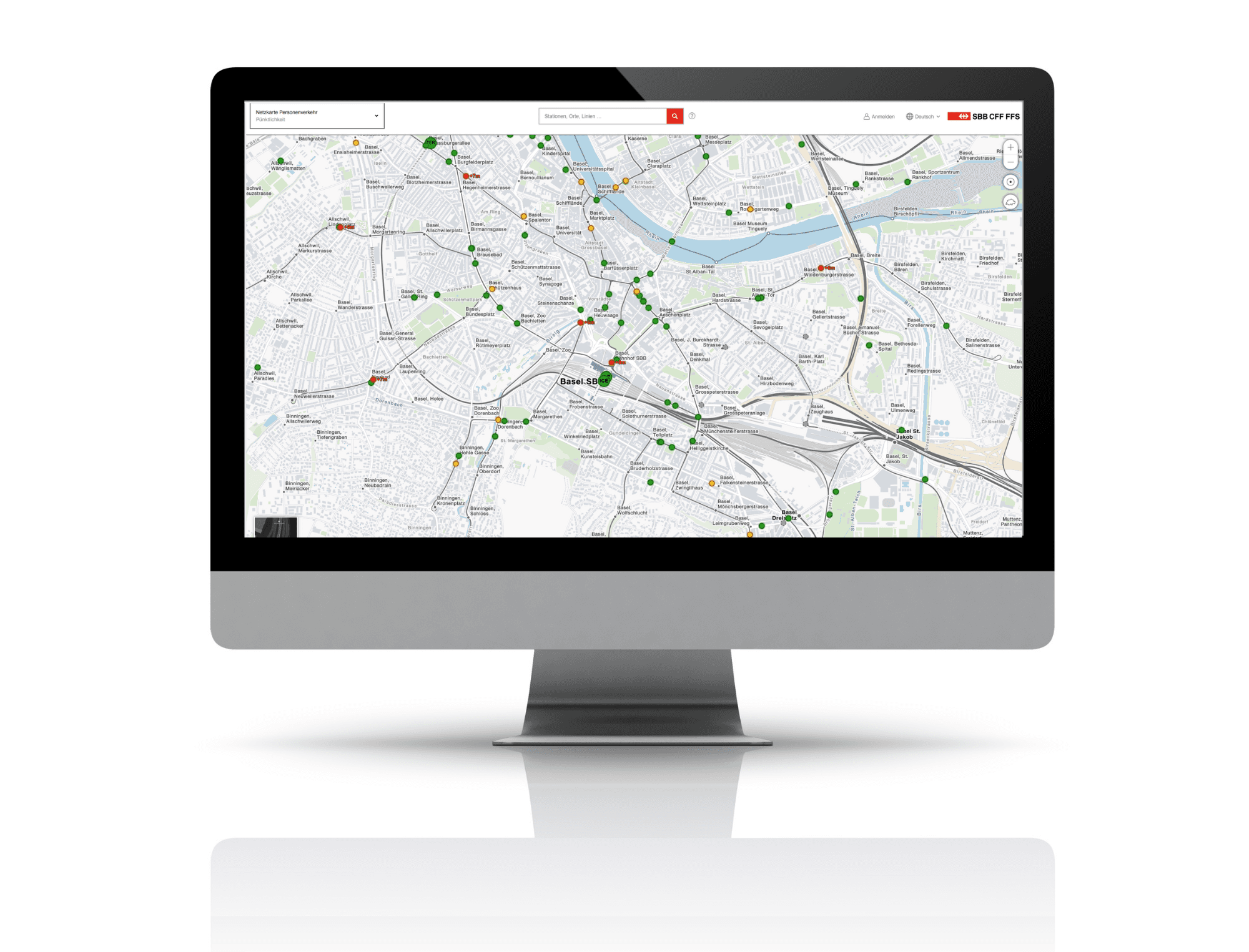
A good example of this application is the punctuality map for Switzerland. It shows exactly which vehicles are running on schedule, which are on time, and which are canceled. This provides a comprehensive overview of both regular operations and disruptions. Even in the event of extreme circumstances, such as the snowfall on January 15, 2021, the full extent of the disruption is visible. We know of several CEOs at transport companies who check this map first thing every morning.

Die technische Basis: TRALIS als Datendrehscheibe und opentransportdata.swiss

The basis of the punctuality map is the same as for our global train trackerTRALIS is optimized to integrate and analyze even large amounts of data and output it back to the customer systems with minimal latency. TRALIS communicates either via interfaces according to standards and quasi-standards such as VDV, NetEX, and GTFS, but also offers specific REST and WebSocket interfaces that are tuned for maximum performance. TRALIS supports many applications. The system is used not only for live maps but also for non-map-based, internal applications such as connection assurance for NVBW. The target and actual data that TRALIS processes for the punctuality map is obtained as GTFS and GTFS-RT from opentransportdata.swiss.

Die technische Basis: TRALIS als Datendrehscheibe und opentransportdata.swiss

Service

Development and operation

Timeline

Ongoing since 2022

Questions?

Get in touch with us

E-Mail: info@geops.ch
Telephone: +41 61 588 05 05

More on this topic
3 min reading time › | Blog

Tree App in transition - refactoring for the future of the forest

The TreeApp has been technically modernized - with TypeScript, Next.js and an integrated database for recommendations. Improved performance, mobile usability and new functions such as sharing your own tree species recommendations round off the update.

read more
3 min reading time › | Blog

geOps at the ÖPNV-Zukunftskongress 2025

We are pleased to announce our participation in the 2nd ÖPNV-Zukunftskongress from May 5 to 7, 2025 in Freiburg im Breisgau!

read more
4 min reading time › | Blog

Managing Python Dependencies with uv

A quick look at how switching to uv improved our Python workflow, replacing tools like pip, pip-tools, and virtualenv with a faster, all-in-one solution—plus tips for migrating existing projects.

read more
2 min reading time › | Blog

mobility-toolbox-js v3

mobility-toolbox-js serves as the primary gateway for developing geospatial web applications using our geOps in-house APIs. This project has existed for years, but version 3 brings massive improvements in terms of development experience, ease of use and integration into existing applications.

read more
2 min reading time › | Blog

Faces of geOps: a portrait of Jessi

In our new interview series “Faces of geOps”, we introduce you to colleagues from the geOps team. Today: Jessi, software engineer with a career change background.

read more
3 min reading time › | Blog

Calculation of municipal contributions to public transport: greater efficiency thanks to digitalisation

Less effort, more transparency: We have developed a digital solution for the Lucerne Transport Association (Verkehrsverbung Luzern VVL) that significantly simplifies the calculation of municipal contributions.

read more

Contact

geOps AG
Solothurnerstrasse 235
CH-4600 Olten

fon: +41 61 588 05 05
mail: info@geops.ch
geOps GmbH
Bismarckallee 10
D-79098 Freiburg im Breisgau

fon: +49 761 458 925 0
mail: info@geops.de
Imprint | Privacy | Terms of service